Eight of Swords — tarot card meaning
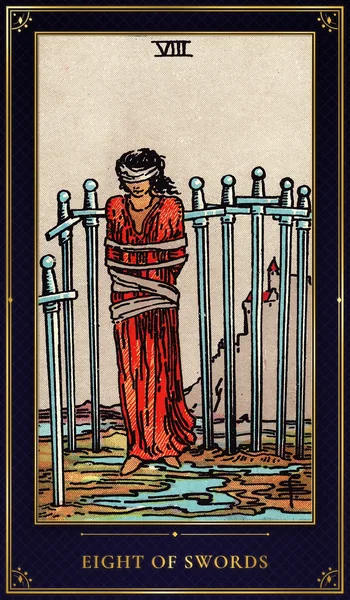
The Eight of Swords is the trap you hold shut yourself: bound and blindfolded among swords that leave gaps, feet free. The everyday version is "I can't", "there's no way out": a feeling far more than a fact. As a person, someone who feels like a hostage.
What the card means
The image on the Rider–Waite card
A woman in a red dress stands blindfolded, arms loosely bound, ringed by eight swords in marshy ground; a castle sits behind her. The knots are loose, there's a clear path between the blades, and her legs aren't tied. She simply can't see it.
Eight of Swords upright
Upright, the Eight of Swords is a sense of powerlessness: circumstances hold you, every step looks dangerous, so you stand still. Most of the limits are in your head. Sometimes the situation is real (a loan, a sick relative), but even then you're seeing fewer options than exist.
Everyday version: you hate the job but "can't leave" because of the mortgage; you've typed the message three times and deleted it.
Eight of Swords reversed
Reversed, the knots come loose. Fear drops, you notice the gap between the swords and take a step, and the restrictions turn out smaller than they felt. Sometimes the release comes from outside: someone helps, the dreaded deadline passes quietly. Less often, a person walks out of one trap and into another.
Eight of Swords in love and relationships
In love, the Eight of Swords is the relationship you "can't leave", or the fear that keeps you from starting one. You feel tied by obligation, guilt, habit, fear of being alone. Single: the first message never gets sent. In a couple: one feels stuck, the other has no idea. Reversed: permission to leave, or to stay by choice.
Work and money
At work the Eight of Swords is a dead-end feeling: a job you can't stand, a boss you're afraid to contradict, a change you want and don't make. Money: dependence on a single income, debts that feel like a cage, a decision postponed because every choice looks risky. Reversed: a new job, a debt cleared.
Eight of Swords as advice
Take off the blindfold and move your feet; they're free. This week: write down exactly what's holding you (name, amount, date) and one step you could take today against each. Ask someone outside the situation to look at your "no way out"; fresh eyes see the gap.
The card as an event marker
In a spread the Eight of Swords marks restrictions a person carries in their head: self-made fears and blocks. With the Two of Swords, a hostage of the situation; with the Devil, a dependence that keeps you in place; with the Moon, fears built on the unknown.
Combinations with other cards
- Two of Swords — Hostage of the situation: eyes closed, hands tied, a decision avoided until it's made for you.
- Strength — Quiet courage beats fear; the handling turns out gentler than you expected.
- The Devil — A dependence that holds you in place (debt, fear, a habit); naming it is the first step out.
- The Star — The blindfold comes off; hope returns and the path between the swords is visible.
A card of the day and full tarot spreads with an AI reading — in the Kodarkan Mini App, free.
✦ Open the tarot app
Frequently asked questions
What does the Eight of Swords mean in love?
Feeling you can't leave a relationship, or being too afraid to start one: guilt, obligation, habit, fear of being alone. You'd like to be rescued rather than choose. Reversed: permission to leave, or to stay because you want to.
Is the Eight of Swords a "no"?
It's closer to "you think it's a no". The card shows limits that live mostly in your head: the swords have gaps and the feet are free. List your real options and ask again; the answer often changes.
What should I do if I draw the Eight of Swords?
Write down exactly what's holding you and one small step you can take today against each item. Ask someone outside the situation for a fresh look, then take the smallest step: one phone call, one application.
What does Eight of Swords reversed mean?
Reversed, the knots come loose. Fear drops, you notice the gap between the swords and take a step, and the restrictions turn out smaller than they felt.
Meanings describe tendencies and are not predictions or medical, legal or financial advice. Illustrations: the Rider–Waite deck (Pamela Colman Smith, 1909), public domain.