Seven of Swords — tarot card meaning
A colleague presents your slide deck as their own and smiles at the applause. That's the Seven of Swords: acting behind someone's back, a plan kept quiet, a shortcut nobody is told about, something taken that wasn't offered. It covers theft and the smart workaround alike; the cards around it say which. As a person, the schemer or the lawyer who knows every loophole.
What the card means
The image on the Rider–Waite card
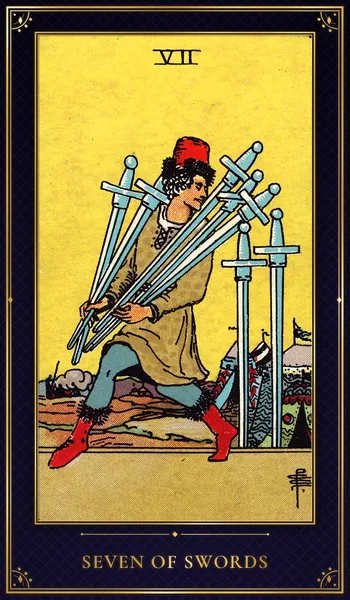
A man tiptoes out of a military camp with five swords, glancing back; two stand in the ground behind him. The scene is deliberately unclear: he may be disarming the enemy or robbing his own side. The glance says he'd rather not be seen.
Seven of Swords upright
Upright, the Seven of Swords is action in secret. Three readings come up most: something taken (an idea passed off as someone else's, a client poached, a partner pulled away); a hidden motive (someone playing a role); and a pattern that repeats, someone leaving and reappearing.
It also shows your own cleverness: a legal workaround, a negotiation won by not showing your hand.
Seven of Swords reversed
Reversed, the secret stops being secret. A cover story falls apart, the missing money is traced, someone admits what they did or gets caught. Sometimes the scheme backfires on the schemer: the shortcut runs into a wall. Honesty is cheaper than it looks right now.
Seven of Swords in love and relationships
In love, the Seven of Swords is a second phone, a dodged question, a relationship kept off social media. With other breakup cards it can point to an affair or someone staying for the apartment. Alone it's smaller: a partner hiding a fear, a debt, an ex they still message. Single: they aren't telling you everything. Reversed: the secret comes out.
Work and money
At work the Seven of Swords is a stolen idea, a colleague who takes credit, a competitor who copies your pricing or poaches your best person. Money: fraud, hidden fees; read the small print. The upside is your own strategy: keeping a plan confidential until it's ready. Reversed: the scheme is exposed.
Seven of Swords as advice
Guard what's yours and leave other people's alone. This week: change the passwords you've been putting off, reread the contract you signed in a hurry, confirm important news with a second source. If you need a workaround, make it a legal one.
The card as an event marker
In a spread the Seven of Swords can flag theft (things, ideas, people), behind-the-scenes games in a court case, or a situation that repeats. With Justice: a lawyer who finds loopholes. With the Lovers: someone leaves and returns. With the Devil and breakup cards it can read as an affair, never alone.
Combinations with other cards
- The Lovers — A relationship with a secret, or a partner who leaves and comes back; with the Devil, infidelity.
- Justice — A legal matter with games behind the curtain: a loophole, a document hiding something.
- The Sun — The hidden comes into the light: the lie is exposed, the facts are visible.
- Page of Swords — Someone is quietly collecting information on you: reading messages, asking around, and not kindly.
A card of the day and full tarot spreads with an AI reading — in the Kodarkan Mini App, free.
✦ Open the tarot app
Frequently asked questions
What does the Seven of Swords mean in a relationship reading?
Secrets and a double game: hidden chats, private plans, something going on behind your back. With other breakup cards it can mean an affair or someone staying for what they get. Alone it's often a smaller secret.
Is the Seven of Swords always about cheating or stealing?
No. Its core is taking something quietly, a thing, an idea, a person, but it's also the card of strategy: a legal workaround, a negotiation won by not showing your hand, a plan kept confidential until it's ready.
What does the Seven of Swords reversed mean?
Exposure. The deception is discovered, the stolen thing returned, the person confesses or gets caught. Sometimes a scheme backfires on its author; less often it warns that you're too trusting and should read the small print.
Meanings describe tendencies and are not predictions or medical, legal or financial advice. Illustrations: the Rider–Waite deck (Pamela Colman Smith, 1909), public domain.