The Devil — tarot card meaning
The Devil is about money, the body and control, not about demons: addiction, pressure you have to bend to, temptation, a relationship built on calculation, big money that comes with a price. It's a working card: pressure and influence, and at the same time simply money.
What the card means
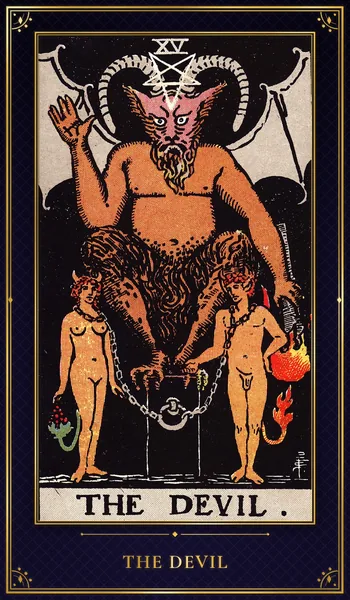
The image on the Rider–Waite card
A horned, winged figure squats on a black cube. Below him a naked man and woman stand chained, with small horns and tails of their own. The chains around their necks hang loose: they could lift them off at any moment, and don't.
The Devil upright
Upright, the Devil means dependence and pressure: someone leaning on you, or tight circumstances you have to fit around. A loan, a bond you can't leave, a habit you feel bad without.
The other side is money and power: large sums, business, taxes, sex and passion, everything that attracts and holds. Say you hate the job but the mortgage is due, so you stay. The key is finding the chain: what exactly holds you.
The Devil reversed
Reversed, the Devil is the chain coming off: leaving a crushing job, ending a relationship based on money or fear, a manipulator exposed, or realizing that the only thing holding you was your own consent. The less pleasant version is a hidden dependence, or giving in to temptation.
The Devil in love and relationships
In love, the Devil is attraction with a lot of body and little freedom: passion, jealousy, control, a relationship held together by money or fear, or a painful attachment to someone you barely know, say from a few weeks of texting. On its own it can be pure chemistry. Reversed: leaving such a bond, or admitting money held you, not feelings.
Work and money
At work, the Devil is money, power and pressure: big business, sales with large commissions, finance, tax, law, anything with high stakes. It can also be the job you hate but keep for the pay, or a boss who leans on you. In money there's plenty, but with strings: loans, collateral, gray schemes, dependence on one client.
The Devil as advice
Look at what's holding you and name it honestly: the addiction, the fear of being broke, the habit. Don't promise yourself "I'll quit tomorrow"; take one concrete step today: close the credit card, say no, walk out of the conversation. Stay out of schemes where the profit looks too good.
The card as an event marker
In a spread, the Devil marks money in a dispute, an expensive lawyer; in tax matters, a claim over money. In relationship questions it marks a bond built on dependence or calculation, and with the Lovers or the Empress, infidelity or a kept relationship.
Combinations with other cards
- The Lovers — A relationship held by dependence or calculation, often an affair; check what the bond rests on.
- Judgement — Money and legal responsibility: fix the mistakes, pay what's owed, don't hide from the tax office.
- The Empress — A kept relationship, a mistress or a sugar arrangement; in money, the lure of easy profit.
- The Moon — Fears and inner demons, a dependence you won't look at; self-deception, not an outside threat.
A card of the day and full tarot spreads with an AI reading — in the Kodarkan Mini App, free.
✦ Open the tarot app
Frequently asked questions
What does the Devil mean in a love reading?
Strong attraction with a taste of dependence: passion, jealousy, control or calculation; the person you can't stop texting even when it hurts. With the Lovers or the Empress it can point at infidelity or a kept relationship.
Is the Devil a bad card?
No, it's a card that demands honesty. It shows money, power, the body, and whatever holds you: the loan, the habit, the job kept for the pay. At work it can be strong motivation; in relationships, a warning.
What does the Devil mean for work and money?
Big money and pressure: business, finance, tax, a hard boss, or a job kept only for the pay; sales where the commission is large and so is the stress. Next to Judgement or Justice, don't hide income.
What does the Devil reversed mean?
Reversed, the Devil is the chain coming off: leaving a crushing job, ending a relationship based on money or fear, a manipulator exposed, or realizing that the only thing holding you was your own consent. The less pleasant version is a hidden dependence, or giving in to temptation.
Meanings describe tendencies and are not predictions or medical, legal or financial advice. Illustrations: the Rider–Waite deck (Pamela Colman Smith, 1909), public domain.