Five of Swords — tarot card meaning
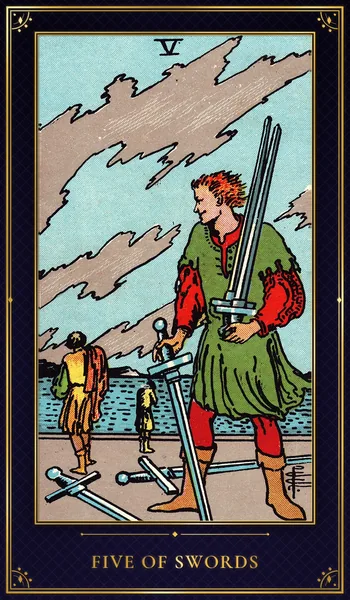
The Five of Swords is the fight where somebody won and everyone lost. It sounds like "they walked over me", a score settled at any price. A crisis card about competition and standing up for your rights; it asks what the win will actually cost. As a person, someone who collects the swords and walks off alone.
What the card means
The image on the Rider–Waite card
A young man with a smirk gathers up swords dropped by two defeated figures walking away toward the sea under a torn sky. He has won the field and stands on it alone, with more swords than he can carry.
Five of Swords upright
Upright, the Five of Swords means conflict with losses: a quarrel where lines were crossed, a victory that tastes of shame, a defeat that leaves a grudge. Think of the group chat where you had the last word and then nobody replied for a week. In a breakup, two people proving something at a cost to both; next to Justice or Judgement, a case that will probably go to court.
Five of Swords reversed
Reversed, the conflict runs out of breath. Both sides are tired, somebody gives ground, a truce or even reconciliation becomes possible, and one person admits they went too far. The other version is anger gone underground: no open fight, but the grudge smolders and waits for a reason.
Five of Swords in love and relationships
In love, upright, this is a quarrel with humiliation, a power struggle, words you won't forget: "I treat you like a war zone". Singles: rivalry, toxic flirting, someone scoring points off you. Couples: an argument both lose; time to change the rules of talking or bring in a counselor. Reversed, a truce, or a cold war.
Work and money
At work the Five of Swords is office politics, being undercut, a clash with a manager, a win after which nobody wants to work with you. With money: a dispute over splitting something, legal costs; in business, unfair competition. Count the price as well as the prize. Reversed, the conflict is damped down or postponed.
Five of Swords as advice
Don't win at any price. Ask what will be left after the victory: the relationship, your reputation, the partner. If the argument isn't worth it, walk away first; that isn't losing. If you must fight, do it by the rules and with documents.
The card as an event marker
As a marker, the Five of Swords signals a conflict, an ugly dispute in legal matters, confrontation during a breakup, and, next to Justice or Judgement, a case that goes to court. With the Four of Pentacles, a fight over property. Alone it's a quarrel, not a verdict.
Combinations with other cards
- Justice — The dispute turns formal: defend your rights officially, with paperwork; the other side will too.
- The Fool — A fight after which someone simply leaves, without looking back or finishing the conversation.
- Four of Pentacles — Dividing property: "you won't get what's mine", a fight over the apartment or the savings.
- Two of Cups — A quarrel inside a real bond; this one is worth repairing rather than winning.
A card of the day and full tarot spreads with an AI reading — in the Kodarkan Mini App, free.
✦ Open the tarot app
Frequently asked questions
What does the Five of Swords mean in love?
A fight with humiliation and a power struggle: words that won't be forgotten, two people trying to prove something. The winner of the argument still loses the evening. Reversed, a truce or a grudge that smolders under the surface.
Is the Five of Swords a no?
More like "yes, but at what price". It shows a win with losses or a defeat with a grudge; the answer depends on whether the fight is worth it. Asked about a promotion, you may get it and lose the team.
Does the Five of Swords mean a court case?
Next to Justice or Judgement it suggests the case will go ahead. On its own it is conflict and a scramble for what's yours, not a court date: an argument with a landlord, say, that hasn't reached paperwork.
What does Five of Swords reversed mean?
Reversed, the conflict runs out of breath. Both sides are tired, somebody gives ground, a truce or even reconciliation becomes possible, and one person admits they went too far.
Meanings describe tendencies and are not predictions or medical, legal or financial advice. Illustrations: the Rider–Waite deck (Pamela Colman Smith, 1909), public domain.