Justice — tarot card meaning
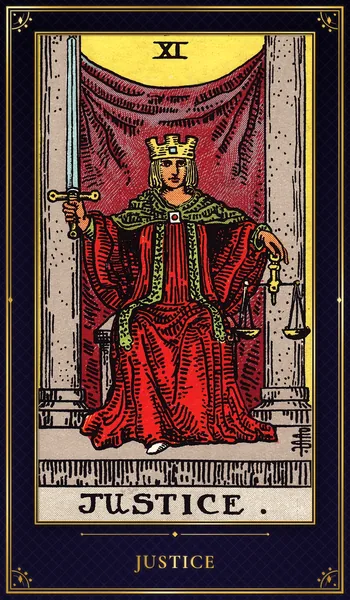
Justice is the card of things settled fairly and by the book: a contract signed, a verdict delivered, a bill split the way it should be. It covers courts, paperwork, marriage and divorce registration. As a person it is a judge, an accountant, or someone who keeps their word and expects the same from you.
What the card means
The image on the Rider–Waite card
A woman in a red robe sits between two pillars, a sword raised in her right hand and scales in her left. She wears no blindfold: she sees everything and weighs it exactly. The sword is the decision, the scales the measure, the pillars the law on either side.
Justice upright
Upright, Justice means the matter gets resolved honestly and everyone receives what they are owed. It is the card of documents and institutions: the lease, the court date, the marriage license. It also asks for balance: if you've tipped everything into work, it points back at home.
Say you've waited three weeks on a decision about your deposit. Justice says it'll be decided on the facts, so gather the photos and the emails.
Justice reversed
Reversed, the scales are tipped. The ruling is unfair, the paperwork drags, the contract quietly favors the other side, or you're the one not seeing straight. It can also be responsibility dodged: "that'll do, nobody will check".
Justice in love and relationships
Upright, Justice brings equal partnership, often with an official side: an engagement, a marriage registration, a written agreement about money. Both people put in the same and promises are kept.
Reversed, one partner lives at the other's expense, or a breakup becomes a long fight over who gets what.
Work and money
Justice covers everything official: contracts, audits, taxes, a dispute with HR. An employer who promised a bonus and hasn't paid is a Justice story, and it gets resolved through the proper channel rather than a shouting match. In money it means a fair settlement: you receive what is due, no more and no less.
Justice as advice
Put everything in writing this week: the agreement, the receipt, the message trail. Read the contract before you sign it, small print included. If a dispute is already running, see a professional and tell them the whole story, including the parts that make you look bad.
The card as an event marker
In a spread, Justice is the main marker for legal matters: a lawsuit, a contract, official papers, formalizing a divorce. Next to Judgement it points to a verdict from an institution; with the Hierophant, a registration or ceremony. Alone it shows the principle, not the event; a court card beside it names the people.
Combinations with other cards
- Wheel of Fortune — a turn for the better made official: a marriage, a favorable contract, a case decided your way.
- The Hierophant — the formal route: a registry office, a notary, an institution ruling strictly by the rules.
- The Devil — money and taxes under scrutiny: hide nothing, file properly and keep the receipts.
- Five of Swords — a dispute where someone plays dirty; the honest side wins with documents.
A card of the day and full tarot spreads with an AI reading — in the Kodarkan Mini App, free.
✦ Open the tarot app
Frequently asked questions
What does Justice mean in a love reading?
Honesty and equal effort, often with an official step: an engagement, a marriage registration or divorce paperwork. Asked whether a partner is faithful, Justice usually reads as "yes, they are". Reversed, one person gives far more than they get back.
Is Justice a good card for a court case?
It is the main court-case marker in the deck. It promises a fair outcome rather than a win: if your facts and papers are in order, the decision goes your way. Nearby court cards show the judge and the other party.
Why is Justice number 8 here when the card says XI?
In the Rider-Waite deck Strength is VIII and Justice is XI. This site numbers the Major Arcana the other way round, 8 for Justice and 11 for Strength. The meaning of the card doesn't change, only its place in the list.
What does Justice reversed mean?
Reversed, the scales are tipped. The ruling is unfair, the paperwork drags, the contract quietly favors the other side, or you're the one not seeing straight.
Meanings describe tendencies and are not predictions or medical, legal or financial advice. Illustrations: the Rider–Waite deck (Pamela Colman Smith, 1909), public domain.