Four of Swords — tarot card meaning
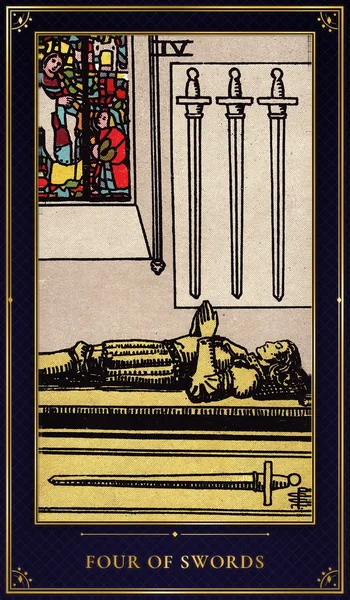
The Four of Swords is the card of the pause: lie down, breathe out, recover. It sounds like "I need a break", "let's wait", a week with the phone off. Swords are thoughts; the four says your thinking needs a rest before it can be sharp again. As a person: someone convalescing or out of reach.
What the card means
The image on the Rider–Waite card
A knight lies on a stone tomb, hands folded, under a stained-glass window. Three swords hang on the wall above him; one lies beneath him. This isn't death: it's a soldier's rest between battles, weapons put away but close at hand.
Four of Swords upright
Upright, the Four of Swords means you need a rest and a temporary stop. A vacation, sick leave, a retreat, a deliberate stretch of solitude: you go away, switch the phone off, sit with yourself. Say you have a big decision about moving cities; the card says four days of not deciding will change nothing, and you'll decide better rested. Sometimes it shows self-restriction: working hard and allowing yourself nothing. It is "not now" rather than "no".
Four of Swords reversed
Reversed, the Four of Swords has two poles. One: the rest is over, strength is back, you get up and take the job on. Two: no rest and never will be, you squeeze yourself dry, or the pause becomes stagnation, four months in bed instead of four days. Movement cards nearby mean the first; The Hanged Man, the second.
Four of Swords in love and relationships
In love, upright, this is a pause: time to think, a stretch apart, no relationship talks on an empty tank. Singles: a recovery period after the last story. Couples: a silence that heals if both know why it's there, and a drift if nobody says what's happening. Reversed: the silence breaks, or hardens into distance.
Work and money
At work the Four of Swords is leave, sick days, a quiet phase in a project, planning without moving. With money it's stable and still: don't spend, don't invest, wait. The right card for someone burned out, the wrong one for an urgent deal. Reversed, back to work after the break, or no day off until you drop.
Four of Swords as advice
Choose days when you decide nothing: sleep, walks, quiet. Put the big decision off; a few days won't change it. If tiredness has turned into feeling ill, see a doctor, not the cards.
The card as an event marker
As a marker, the Four of Swords points to a pause: rest, a vacation, sick leave or treatment, a project frozen. It names a stop, not an illness; a health question goes to a doctor. Stronger next to the Ten of Wands (overload), The Hermit or The Hanged Man.
Combinations with other cards
- Ten of Wands — Overload that demands a rest: stop yourself before your body stops you.
- The Star — Recovery going well: after the pause, a clear goal and the strength to reach it.
- The Hanged Man — The pause is dragging on; ask honestly whether this is rest or getting stuck.
- Knight of Wands — The break is over: you're up and moving again, faster than before.
A card of the day and full tarot spreads with an AI reading — in the Kodarkan Mini App, free.
✦ Open the tarot app
Frequently asked questions
What does the Four of Swords mean in love?
A pause: time to think, time apart, no big talks when you're exhausted. It says "let's wait, not now", and it isn't a breakup card on its own. Reversed, the pause ends with a conversation, or quietly turns into distance.
Is the Four of Swords a no?
It is "not now". The card doesn't refuse, it postpones: recover first and come back to the question with a clear head, usually within days rather than months. Asked "will I get the job?", it means delayed, not declined.
Does the Four of Swords mean illness?
It can mean sick leave, treatment or simple exhaustion, alongside vacation and rest. Cards don't diagnose: if you feel unwell, see a doctor. In a spread about a project, the same card just means a frozen phase.
What does Four of Swords reversed mean?
Reversed, the Four of Swords has two poles. One: the rest is over, strength is back, you get up and take the job on.
Meanings describe tendencies and are not predictions or medical, legal or financial advice. Illustrations: the Rider–Waite deck (Pamela Colman Smith, 1909), public domain.