Seven of Wands — tarot card meaning
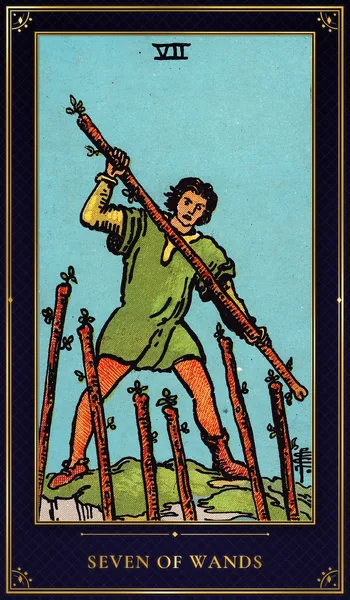
Relatives against the relationship, a rival after your best client: the Seven of Wands is defense, you on top, others pushing from below, holding what's yours. "Fend them off, stand your ground." You have the advantage, but can't relax. As a person, it's someone who defends, and sometimes over-explains.
What the card means
The image on the Rider–Waite card
A man stands on a rise with a wand held crosswise; six wands point up at him from below, and the opponents are not visible. The position is strong, but he holds it alone. He wears two different shoes: he dressed in a hurry.
Seven of Wands upright
Upright, the Seven of Wands means you have something to defend, and you can manage it: a court case, a clash with the boss, fending off competitors. You're higher up, with experience or position, and that's being tested.
Say a new colleague is pitching for your accounts and you spend the week proving you still run them best. It also limits you: hard to start anything new while on guard.
Seven of Wands reversed
Reversed, the defense wears you out, or the enemy isn't there. Someone gives up too early, keeps defending something no longer worth it, or sees an attack where there is none: feeling that everyone is after you doesn't mean they are. Check whether the threat is real, then hold or let go in peace.
Seven of Wands in love and relationships
In love, the Seven of Wands is defending the relationship from outside pressure: relatives against it, an ex interfering, a rival appearing. Or it's defense inside the couple, each holding their line. To "will he call" it leans toward no. Reversed, tiredness from fighting for the relationship, or jealousy of an invented rival.
Work and money
At work this is holding your position: defending a project to management, competing with newcomers, arguing with the boss, keeping a client. Sometimes it's the climb itself. In money, it is protecting what is yours: not giving ground in negotiations, seeing off claims on your property. Favorable while you hold; risky once you tire.
Seven of Wands as advice
Hold your ground. Decide exactly what you are defending, the project, the relationship, a boundary, and defend that rather than everything at once. Argue instead of justifying yourself. If your strength is running out, call for help rather than stepping down.
The card as an event marker
The Seven of Wands shows up in breakup and property readings as a claim on what is yours: a former partner trying to take more. It also marks defending yourself in court and conflict with a boss. In women's health readings it has been read as conflict; that is a prompt to see a doctor, not a conclusion.
Combinations with other cards
- Five of Swords — a fight where someone walks over others; defend yourself seriously and keep the paperwork.
- Six of Wands — the defense holds: you keep the position and get recognized for it.
- Ten of Wands — the defense is exhausting; drop part of the load or get help.
- Justice — a dispute that goes formal: a court case where you defend your terms.
A card of the day and full tarot spreads with an AI reading — in the Kodarkan Mini App, free.
✦ Open the tarot app
Frequently asked questions
What does the Seven of Wands mean in love?
Defending the relationship from outside pressure (relatives, an ex, a rival), or a standoff inside the couple where each holds their line. The person of this card explains themselves a lot, keeps their distance, and answers "will you call?" with a maybe.
Is the Seven of Wands a yes?
Yes, if you're ready to fight for it: the position, the client, the deal. With decent cards beside it, it works out; two bad cards next to it mean the opponents are stronger and the cost is high.
What does the Seven of Wands reversed mean?
Worn out from defending, giving up the position, or an imagined threat: it feels as if everyone is after you, and the quiet colleague becomes a plotter. Check whether the danger is real before spending more strength.
Meanings describe tendencies and are not predictions or medical, legal or financial advice. Illustrations: the Rider–Waite deck (Pamela Colman Smith, 1909), public domain.