Five of Wands — tarot card meaning
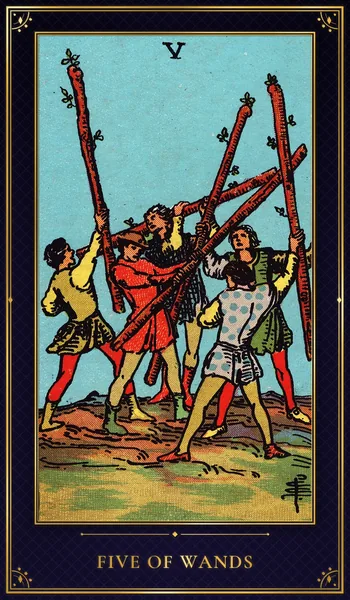
Everyone in the meeting is talking over everyone and nobody is listening: the Five of Wands is rivalry, everyone waving a stick and proving a point. An argument, a contest, a fight for attention or a place, "who is stronger". As a person, someone who picks fights and carries too much at once.
What the card means
The image on the Rider–Waite card
Five young men in different-colored clothes swing their wands at each other; it is not clear whether they fight or play, and nobody is hurt. This is noise and jostling, the kind that ends either in rules or in exhaustion.
Five of Wands upright
Upright, the Five of Wands means competition and arguments that drain you without wounding anyone. At work it's several people after the same post.
Say three of you applied for the same promotion and the team chat has gone quiet and sharp. That's the Five of Wands: not enemies, force without rules. Add rules and it becomes a team or a sporting contest.
Five of Wands reversed
Reversed, the argument either ends or gets swept under the rug. Either the conflict is spent and both sides agree to stop, or the rivalry carries on quietly: intrigue, grudges, competing behind backs. Or someone avoids any confrontation at their own expense. Name the disagreement out loud and close it, or admit it's not worth the effort.
Five of Wands in love and relationships
In love, the Five of Wands is a fight for the upper hand inside a couple, or competition for a person. Each partner proves they are right; small quarrels come from tiredness and the wish to win. Single, it's several admirers at once, a spark that tips into a blowup easily. Reversed, the quarrels die down or turn into silent point-scoring.
Work and money
At work this is a bid, a contest, a race for a position, team arguments, overload. You're not the only candidate; the one who keeps a cool head usually wins. In money it is fighting for a client or a budget, and many small expenses born of the rush.
Five of Wands as advice
Don't try to prove everyone wrong at once. Pick the one argument worth winning and the rules you'll play by. If this is a team, give each person a role and the noise becomes work. If this is a relationship, stop competing over who is right.
The card as an event marker
The Five of Wands is not an event marker on its own; it marks strain and a combative mood. By its neighbors: with the Seven of Wands, a long standoff; with the Six of Wands, a contest you win; with the Five of Swords, an argument that gets dirty rather than sporting.
Combinations with other cards
- Six of Wands — a competition you win: a contest, a bid, a selection round.
- Seven of Wands — a long fight: you will be defending your position for a while.
- The Lovers — rivalry for a person, or a couple competing for the upper hand.
- Five of Swords — the sporting contest turns nasty: someone plays dirty to win, and the rules go out the window.
A card of the day and full tarot spreads with an AI reading — in the Kodarkan Mini App, free.
✦ Open the tarot app
Frequently asked questions
What does the Five of Wands mean in love?
A struggle for the upper hand, or rivalry for someone: quarrels that come from wanting to be right, or several admirers at once, two people texting you the same evening. It reads as "who is stronger", not as a breakup.
Is the Five of Wands a yes or no?
More "yes, but through a fight". The result is possible if you stand the competition and don't fall apart from the rush: the bid can be won, the position can be yours. Reversed, the contest fizzles.
Is the Five of Wands a bad card?
No. It's a card of strain and competition without malice, the noisy group project rather than the knife in the back. It tires you but doesn't destroy anything; with rules it becomes sporting drive and teamwork.
What does Five of Wands reversed mean?
Reversed, the argument either ends or gets swept under the rug. Either the conflict is spent and both sides agree to stop, or the rivalry carries on quietly: intrigue, grudges, competing behind backs.
Meanings describe tendencies and are not predictions or medical, legal or financial advice. Illustrations: the Rider–Waite deck (Pamela Colman Smith, 1909), public domain.