Knight of Swords — tarot card meaning
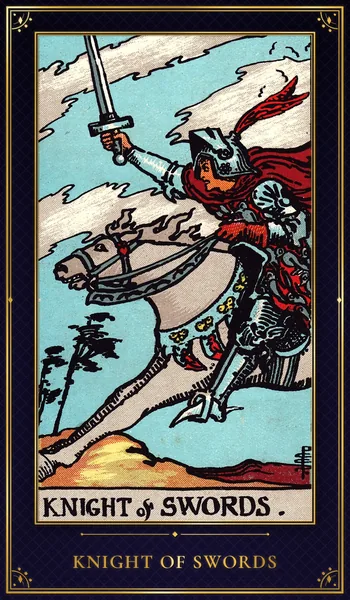
The Knight of Swords is the charge: a rider at full gallop, sword out, no time to think. Read it as "very fast", "out of nowhere", "decide now". As a person, the one who's always moving and never unprepared to fight: couriers, pilots, the colleague who answers before you finish the question.
What the card means
The image on the Rider–Waite card
A knight on a gray horse races into the wind, sword raised; the clouds are ragged and the trees bend. No pause, no looking back, only speed and a target.
Knight of Swords upright
Upright, the Knight of Swords means rapid development and abrupt news, sometimes shocking. Decisions have to be made fast, and there's no time to prepare. It's one of the travel cards; with the Eight of Wands it's unexpected guests.
Everyday version: a job offer that wants an answer by Friday, a partner who insists on moving in next month, a message that rearranges your week. As a person he's sharp and decisive but short on experience. In legal matters he's the lawyer who attacks.
Knight of Swords reversed
Reversed, it's pressure without a mind behind it: aggression, rudeness, words flung out in passing that wound, decisions made in a temper, a conflict you charged into without understanding it. Or a rider who promised and galloped off. Before the important conversation, count to ten.
Knight of Swords in love and relationships
In love, the Knight of Swords is a whirlwind meeting, a pushy suitor, sudden news about the relationship. Single: someone appears out of nowhere and wants everything fast; check you can keep up. In a couple: a blowup at raised voices. Sometimes it's an ex who suddenly reappears. Reversed: rudeness, a person who vanishes as fast as he came.
Work and money
At work the Knight of Swords is urgent tasks, a deadline, quick decisions, abrupt news, a business trip. Good in a crisis, poor at long planning; as a hire he's fast but inexperienced. Money: sharp moves, a quick deal, a sudden expense, a hurried investment; don't sign anything on the run. Reversed: a clash with the boss, a decision you'll regret.
Knight of Swords as advice
Act fast, but look where you're galloping. This week: if the situation calls for speed, decide now; hesitating costs more. But reread the message once before you send it. An argument is won by the better point, not the louder voice.
The card as an event marker
In a spread the Knight of Swords marks sudden news, speed, a trip, and quick decisions. With the Eight of Wands, unexpected guests or news within hours; with Justice, a lawyer and fast legal action; with the Tower, an abrupt event at speed: take care on the road. One card alone is a tempo, not an event.
Combinations with other cards
- Eight of Wands — Unexpected guests or rapid news; things happen within hours rather than days.
- The Tower — A sharp event at speed: a sudden break, plans overturned, caution while traveling.
- Justice — A lawyer in the case; fast legal moves and a decision that won't wait.
- The Lovers — A whirlwind romance or a quick choice in a relationship, made before you catch your breath.
A card of the day and full tarot spreads with an AI reading — in the Kodarkan Mini App, free.
✦ Open the tarot app
Frequently asked questions
What does the Knight of Swords mean in love?
A whirlwind meeting or a pushy partner, sudden news about the relationship: someone insisting on moving fast. Single: check that you can keep up. Reversed: rudeness, a person who vanishes as fast as he came.
Does the Knight of Swords mean "soon"?
Yes, very soon. It's one of the fastest cards in the deck: surprises, news, a decision within a minute. Often a trip or unexpected guests as well. Asked "when?", think hours or days, not weeks.
Who is the Knight of Swords as a person?
A fast young man who speaks before he thinks: a courier, a pilot, a debater, someone who charges in without preparation. In legal readings, the lawyer who attacks. As a hire he's quick but can't yet decide things on his own.
What does Knight of Swords reversed mean?
Reversed, it's pressure without a mind behind it: aggression, rudeness, words flung out in passing that wound, decisions made in a temper, a conflict you charged into without understanding it. Or a rider who promised and galloped off.
Meanings describe tendencies and are not predictions or medical, legal or financial advice. Illustrations: the Rider–Waite deck (Pamela Colman Smith, 1909), public domain.