The Tower — tarot card meaning
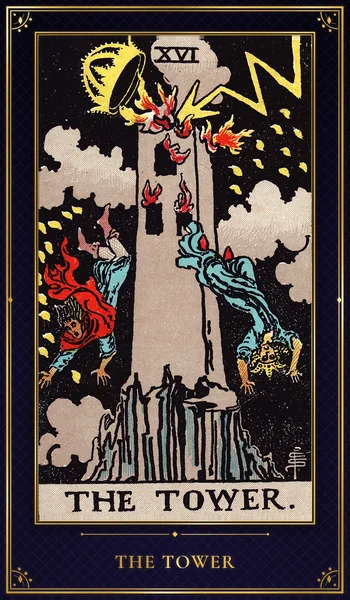
The text that ends it arrives out of a clear sky, or the landlord gives you a month: that's the Tower, a sudden event that wrecks the plan, a layoff with no warning, a break-up, a breakdown, a sharp piece of news. "Everything fell apart in one day." At its best, the Tower is release: from isolation, from a hated job, from the role of victim.
What the card means
The image on the Rider–Waite card
Lightning strikes a tall tower on a rock, the crown flies off the top, two figures fall from the windows, flames all around. The tower stood on stone but was shut off from the world and built on pride; the lightning takes down what wouldn't have held anyway.
The Tower upright
Upright, the Tower means a sharp change you didn't plan, and it hits at once, unlike Death, where a chapter closes gradually: plans ruined, something breaks today, bad news.
There's a second layer: after the collapse you see what's real. Say the company announces closure on Tuesday, and by Friday you're applying for the job you should have looked for a year ago.
The Tower reversed
Reversed, the Tower is a crisis being postponed, or a blow that was softened. You feel the structure shaking and prop it up instead of rebuilding: you put up with the job, keep quiet at home, patch the budget with credit cards. Sometimes the worst is behind you. A controlled demolition is cheaper than a collapse.
The Tower in love and relationships
In love, the Tower is a sudden break, a blowup, a truth that comes out and changes everything. Next to a document card, the relationship ends officially. For a couple where tension built for years it's the explosion, after which you start again or part. Single, a sharp end to illusions about someone. Reversed: cracking, but nobody says it.
Work and money
At work, the Tower is a sudden dismissal, a company closing, a deal falling through, an accident, lost data. Plan A won't work; you need plan B. In money it means sharp losses, unplanned big expenses, a scheme that bursts.
The Tower as advice
Don't hold on to what's falling. If you see cracks, check the foundation now: the contract, the relationship, the budget. This week, build a reserve: some savings, a backup option, people you can call.
The card as an event marker
In a spread, the Tower marks an abrupt divorce or break-up; in a court case it points at whatever is being fought over: the property, the contract, the custody. With the Chariot, an accident or a vehicle breakdown. As a card of the day, something breaks.
Combinations with other cards
- The Chariot — A breakdown on the move: an accident, a failed trip, a car problem; extra care on the road.
- Ace of Wands — You have to demolish to start something new: a fast restart right after the collapse.
- The Star — The crisis is over and the future is visible again; after the Tower, live here and now.
- Temperance — A broken agreement or balance; if Temperance comes after the Tower, things settle down.
A card of the day and full tarot spreads with an AI reading — in the Kodarkan Mini App, free.
✦ Open the tarot app
Frequently asked questions
What does the Tower mean in a love reading?
A sudden break, a blowup, or a truth that changes everything: the message you weren't meant to see, the bag already packed. It marks an abrupt divorce, and what had been cracking quietly comes down in one day.
Is the Tower the worst card in tarot?
No. It's the card of suddenness: it wrecks plans, but it takes down what wasn't holding anyway, the job that was already bad, the deal built on a handshake. Painful, yes; fatal, rarely, and the Star comes next.
What should I do if I draw the Tower?
Check your foundations (the contract, the budget, the relationship) and set up a backup. Don't prop up what's falling. If it's already happened, give yourself a week before big decisions, then rebuild on your own terms.
What does the Tower reversed mean?
Reversed, the Tower is a crisis being postponed, or a blow that was softened. You feel the structure shaking and prop it up instead of rebuilding: you put up with the job, keep quiet at home, patch the budget with credit cards.
Meanings describe tendencies and are not predictions or medical, legal or financial advice. Illustrations: the Rider–Waite deck (Pamela Colman Smith, 1909), public domain.