Six of Pentacles — tarot card meaning
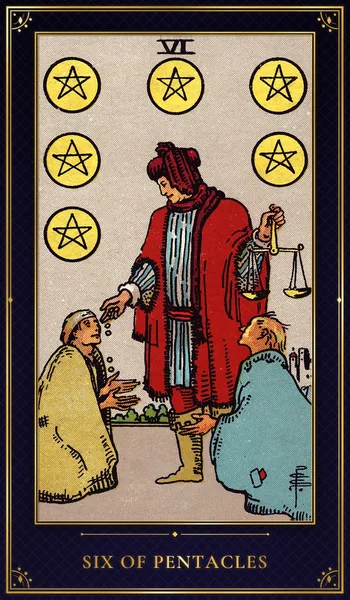
The Six of Pentacles is the merchant with the scales, handing out coins. People say it as "they gave me money", a gift, a bonus, child support, charity, or being the one who gives. As a person: a generous patron, a sponsor, or someone who keeps you on an allowance.
What the card means
The image on the Rider–Waite card
A wealthy man in fine clothes holds a set of scales in one hand and drops coins into the palms of two kneeling beggars with the other. The scales mean measure: he gives what he judges fair.
Six of Pentacles upright
Upright, the Six of Pentacles is help given or received: financial support, a gift, a loan, a payout. Money comes in and goes out the same day: you get the bonus and pay the dentist.
In a divorce spread it's a settlement reached amicably, child support agreed.
Six of Pentacles reversed
Reversed, the exchange tilts. A debt that won't be repaid, help that comes with humiliation or conditions, handouts instead of real support, or you give to everyone and keep nothing for yourself. Review who you give to and on what terms, and don't take from anyone who'll make you pay three times over.
Six of Pentacles in love and relationships
In love the Six of Pentacles is a relationship where one gives and the other receives: patron and protégé, being kept, helping a partner's family. Check that you're equals; financial dependence often sits here. Asked about cheating, it tends to be about money rather than an affair. Single, you may meet a generous person. Reversed, help that demands obedience.
Work and money
At work this is a bonus, a grant, sponsorship, a raise, a charity project, or a job held out of pity, where you're the supplicant. Money-wise: income and expense at once, gifts, benefits, a loan. With the Four of Pentacles, money you put in won't return. Reversed: a loan not repaid, payments delayed.
Six of Pentacles as advice
Give in measure and take without shame. If you can help, help, but not a loan without a signed note. If you need help, ask this week; it'll be given. Then weigh the exchange: is it fair, or are you being put on your knees for a coin?
The card as an event marker
As an event marker the Six of Pentacles signals an agreement over money in a divorce (child support, an amicable split), especially beside Justice or the Two of Cups. Next to the Four of Pentacles it warns that money you lend is gone.
Combinations with other cards
- Four of Pentacles — You give and don't get it back: keep your wallet closed for loans this week.
- Justice — A formal money agreement: child support, a division of assets, compensation set down on paper.
- The Empress — Generosity that pays off: a gift, a sponsor, support that grows into something lasting.
- The Hierophant — Help that comes with rules: a family allowance, an institution, money tied to tradition.
A card of the day and full tarot spreads with an AI reading — in the Kodarkan Mini App, free.
✦ Open the tarot app
Frequently asked questions
What does the Six of Pentacles mean in a money reading?
Help and exchange: receiving money and spending it, a gift, a payout, a loan, a bonus that goes straight to the dentist. Reversed, and asked "will they pay me back?", the answer is: don't count on it.
What does the Six of Pentacles mean in a relationship?
An unequal split of roles, one gives, one receives: patronage, being kept or supported. In a divorce it often shows an agreement on child support. The question to ask is whether the exchange is fair.
Should I lend money if the Six of Pentacles comes up?
If the Four of Pentacles is next to it, no: you won't see it again. On its own, you can help, but in measure and with a written note that names the date, even with family.
What does Six of Pentacles reversed mean?
Reversed, the exchange tilts. A debt that won't be repaid, help that comes with humiliation or conditions, handouts instead of real support, or you give to everyone and keep nothing for yourself.
Meanings describe tendencies and are not predictions or medical, legal or financial advice. Illustrations: the Rider–Waite deck (Pamela Colman Smith, 1909), public domain.