Death — tarot card meaning
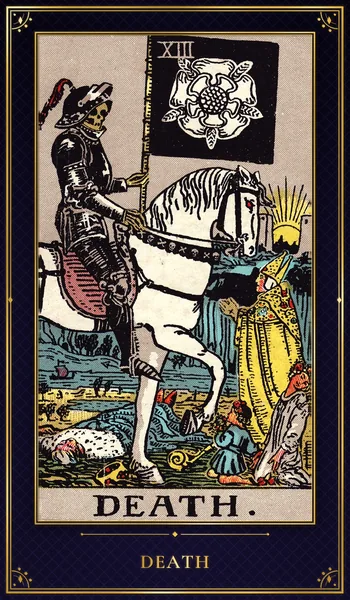
A layoff, a move, a divorce, a project shutting down, the end of a familiar routine: that's Death, the card of completion, one chapter over and the next beginning. It's almost never about physical death; it's about events that turn life around. As a person, someone who changes things.
What the card means
The image on the Rider–Waite card
A skeleton in black armor rides a white horse under a black banner with a white rose. A king has fallen, a child and a young woman kneel, a priest prays. Between two towers the sun is rising: everything old goes down, and the dawn is already up.
Death upright
Upright, Death means an ending and a transformation: a job, a company, a marriage, a way of living is closing. It isn't a catastrophe; it draws a line under what has run its course and clears room for what comes next.
Say you've known for a year that the job is dead, and this month the department is dissolved. That's the end, and it's overdue.
Death reversed
Reversed, Death is an ending that drags. You're holding on to something already finished: a job that's been bad for ages, a relationship kept up out of habit, an old version of yourself. Its softness is delay, like a couple separated in all but name who still share the lease. Finish it yourself.
Death in love and relationships
In love, Death means a relationship ends or changes at the root: either it transforms deeply or it finishes. Unlike the Tower, it's a gradual break that has been ripening. It can also mean one stage of a couple ending and another starting. Reversed, it's long over but nobody says so.
Work and money
At work, Death is a layoff, a project or company shutting down, a career change, a contract ending. Often it was ripe: the job stopped paying or stopped mattering. Bankruptcy is one of its plots, and so is an inheritance. For a business, shut the unprofitable line and start another. In money, one source of income ends; look for the next.
Death as advice
Let go of what is finished. Call it by its name: this job, this relationship, this plan has run out. Close it properly this week: finish the open tasks, say goodbye, settle the accounts, hand in the keys. Don't drag the old stuff into the new chapter.
The card as an event marker
In a spread, Death marks a natural completion: a gradual break-up or a divorce without an explosion, a contract running out, a lease ending. Next to the Lovers it points at separation. In health questions conclusions belong to a doctor.
Combinations with other cards
- The Lovers — A separation, or a relationship that changes beyond recognition; ask what exactly is ending.
- Ace of Wands — The old stage ends and the new one starts at once: a layoff, then a fresh start.
- Ten of Pentacles — Money through a closing, often an inheritance or a buyout; a family matter settles.
- The Tower — An ending that arrives suddenly and loudly; what ripened for months breaks in a day.
A card of the day and full tarot spreads with an AI reading — in the Kodarkan Mini App, free.
✦ Open the tarot app
Frequently asked questions
Does the Death card mean someone will die?
Very rarely, and only with strong confirmation from nearby cards; most readers won't do that reading. Normally Death is the end of a chapter: a job, a relationship, a way of life, the apartment you finally move out of.
What does Death mean in a love reading?
An ending or a root-level change: either the relationship transforms deeply or it finishes, like a couple that separates after years of drifting, or one that becomes parents and is never the same again. Compared with the Tower, the break is gradual.
Does Death in a career reading mean I'll be fired?
Often a layoff, a project closing or a change of profession, but of something that had run its course: the role you've been bored in for a year. Close it yourself rather than wait to be pushed.
What does Death reversed mean?
Reversed, Death is an ending that drags. You're holding on to something already finished: a job that's been bad for ages, a relationship kept up out of habit, an old version of yourself.
Meanings describe tendencies and are not predictions or medical, legal or financial advice. Illustrations: the Rider–Waite deck (Pamela Colman Smith, 1909), public domain.