Three of Wands — tarot card meaning
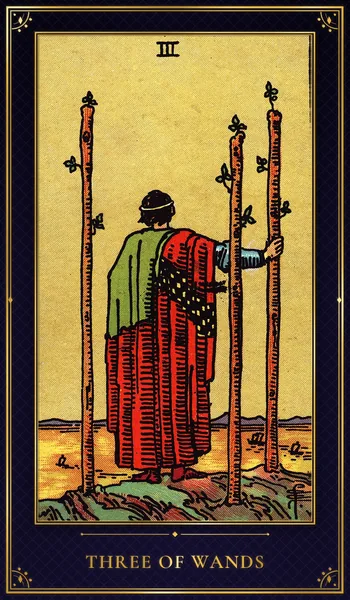
The store opened a month ago and the first repeat customers are coming back: the Three of Wands is the next stage, the first steps done, you watching your ships sail. "The process is under way, now I wait for the result." It's also a travel card. As a person, it's someone who made up their mind and set off.
What the card means
The image on the Rider–Waite card
A man stands with his back to us on a cliff, looking out at ships on the sea; three wands stand around him and he leans on one. The goods have been shipped. Now he waits for them to come back as profit.
Three of Wands upright
Upright, the Three of Wands means growth and waiting for the harvest: the thing is launched, the first results are in, more is coming. Threes are what comes of the Ace and the Two: a move to another city, a college acceptance, a business in its second phase.
Say you sent out ten job applications last week. This card is the stage where two interviews are booked and you prepare instead of refreshing your inbox.
Three of Wands reversed
Reversed, the ships are late. The result still comes, but later and smaller; the trip gets postponed; the expansion didn't pay what the plan said. Sometimes the person won't look ahead and keeps turning back to the harbor. Check the plan against reality, don't quit halfway, and build in extra time.
Three of Wands in love and relationships
In love, the Three of Wands is a relationship at a distance or on the way to its next stage: waiting to meet, moving to be together, plans starting to come true. For a couple it widens the horizon: trips, study, new people. Single, someone met while traveling. Reversed, the wait drags on: one stands on the shore, the other is in no hurry.
Work and money
At work the project is gathering pace: first results are in, new markets are opening, there are business trips and training. In money, the investment is starting to come back, though the full return is still ahead. Reversed, a late delivery or payment, or a miscalculated plan.
Three of Wands as advice
Hold your course and look ahead. The thing is moving, so don't poke at it; prepare the next stage instead: new contacts, a course, a trip. If you're waiting for an answer, fill the time with preparation rather than worry.
The card as an event marker
The Three of Wands is one of the travel and relocation markers, especially beside the Chariot, the World, the Fool, the Six of Swords or the Eight of Wands. It can also point to study. On its own it only says "the next stage is coming".
Combinations with other cards
- The World — a trip abroad, an international project, study or work in another country.
- The Chariot — emigration or a move that actually happens; the plan turns into road.
- Eight of Wands — the trip happens soon and fast; news arrives from far away within days.
- Five of Pentacles — the ships come back light; a delay in money and a plan that needs revising.
A card of the day and full tarot spreads with an AI reading — in the Kodarkan Mini App, free.
✦ Open the tarot app
Frequently asked questions
What does the Three of Wands mean?
The next stage: the project is launched, the first results are in, and expansion, travel or study is ahead. A calm card of waiting for a result already on its way, like the parcel that's shipped but not delivered.
Is the Three of Wands a yes or no?
Yes, with a note of "it is coming, just not immediately". The result will arrive, the way the interviews follow the applications; use the waiting time to prepare the next step rather than refresh the inbox.
What does the Three of Wands mean in love?
A relationship at a distance or heading for its next stage: waiting to meet, moving to be together, shared plans, the flight booked for next month. It is not a card of cheating; it is about prospects and patience.
What does Three of Wands reversed mean?
Reversed, the ships are late. The result still comes, but later and smaller; the trip gets postponed; the expansion didn't pay what the plan said.
Meanings describe tendencies and are not predictions or medical, legal or financial advice. Illustrations: the Rider–Waite deck (Pamela Colman Smith, 1909), public domain.