Ten of Swords — tarot card meaning
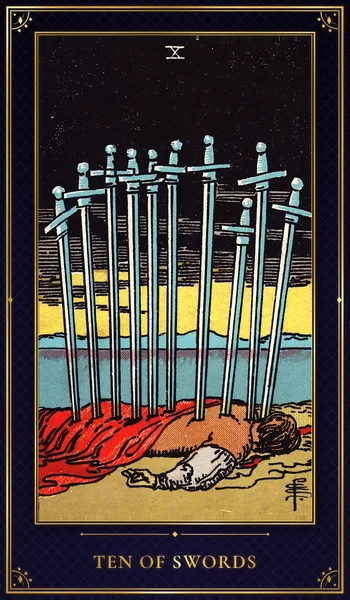
The message says "don't contact me again"; the layoff letter is in your inbox. That's the Ten of Swords: the ending, nowhere further to fall, and exactly why what comes next is sunrise. People say it as "it's over, they've buried it", a painful, final close. It almost never means physical death; a chapter is finished.
What the card means
The image on the Rider–Waite card
A man lies face down with ten swords in his back. The sky is black, but along the horizon a band of light is breaking. This is the bottom, and the bottom is what you push off from.
Ten of Swords upright
Upright, the Ten of Swords means an ending, painful but final. A relationship collapses and can't be brought back; a stage closes badly and a new one begins. With the Three and Four of Swords it shows someone crushed by what happened. The key to the card is the light on the horizon: the full stop has been put, and however much it hurts, it's a release.
Ten of Swords reversed
Reversed, the swords are being pulled out. Recovery after the blow, getting up off the floor: "I survived, I'm standing". Or the opposite: an ending that isn't allowed to happen, someone dragging out the inevitable. Neighbors decide: the Star or Ace of Wands mean getting up; the Hanged Man means stalling.
Ten of Swords in love and relationships
In love, the Ten of Swords is the final break: a door that has shut. "Will we make up?" leans no; this version is buried. Single: the old story is closed; painful, but it frees you. The light on the horizon is a new relationship, or the same two people starting from scratch. Reversed: a long recovery, or an agony dragged out.
Work and money
At work the Ten of Swords is dismissal, a business closing, a failed project, partners who betray you. Money: loss, the bottom, a venture that goes under; after the Ten the count starts again from zero. Don't resuscitate what's dead; close it and recover. Reversed: a comeback after the crash, or a loss-making thing nobody will let die.
Ten of Swords as advice
Admit the ending and rest before you get up. This week: stop trying to revive what's finished. Close the accounts, say the goodbye, cry it out. Then look at the horizon; it's getting lighter. Leaning on close people or a counselor is appropriate.
The card as an event marker
In a spread the Ten of Swords marks the painful end of a stage. With the Lovers it's the end of love. In health readings it can point to an operation, a marker only; conclusions belong to a doctor. Physical death it shows extremely rarely; several cards would have to confirm it.
Combinations with other cards
- The Lovers — The end of love; nothing to bring back, something new ahead once the grief passes.
- The High Priestess — A closed stage ends painfully and a new state begins; the hidden reason surfaces later.
- Ace of Wands — After the bottom, a sharp new start; strength enough, if you don't look back.
- The Hanged Man — An ending that's being postponed; someone won't let go and keeps the agony alive.
A card of the day and full tarot spreads with an AI reading — in the Kodarkan Mini App, free.
✦ Open the tarot app
Frequently asked questions
What does the Ten of Swords mean in love?
A final break: asked "will we make up", it leans no; this version of the relationship is hard to revive. With the Lovers it's the end of love. But the picture has a sunrise: the next chapter is beginning.
Does the Ten of Swords mean death?
Very rarely, and only when several other cards confirm it. Normally it's the painful end of a stage (a job, a relationship, a venture) with nowhere further to fall and light already on the horizon.
What does the Ten of Swords reversed mean?
Recovery after a blow, getting up off the floor, or an ending being dragged out when someone won't let the inevitable happen. Let the ending happen, and once you're up, don't rush back into the fight.
Meanings describe tendencies and are not predictions or medical, legal or financial advice. Illustrations: the Rider–Waite deck (Pamela Colman Smith, 1909), public domain.